The short answer
What jewelry marks should you look for at estate sales, and what are they worth?
Check 14K/585, 18K/750, the plated marks (GF, RGP, HGE), 925 Mexican silver, Tiffany, James Avery, Eisenberg Original, Miriam Haskell, Weiss, Bakelite (no mark, so test it) and Native American artist hallmarks. On eBay, an 18K/750 rolo chain sold for $1,550 on Nov 4, 2026; one listed "18K GF" sold for $56. Read every letter after the K.
- Read every letter after the K: an 18K/750 rolo chain sold for $1,550 (Nov 4, 2026), a chain listed "Au750 18K GF" for $56 (Oct 29, 2026).
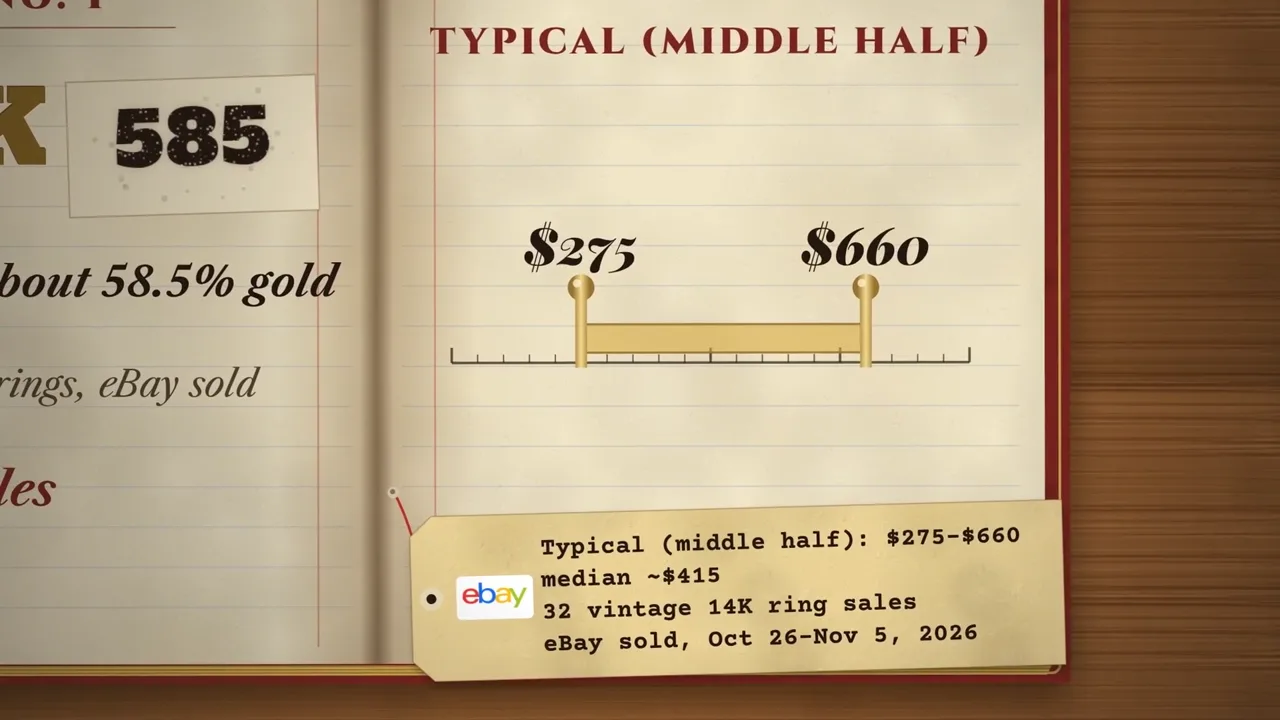
- The middle half of 32 vintage 14K ring sales on eBay (Oct 26-Nov 5, 2026) ran $275-$660, median about $415; price follows gold weight plus stones.
- Under the FTC Jewelry Guides, gold filled is a 10K+ gold layer of at least 1/20 of the metal's weight; rolled gold plate only needs 1/40.
- Signed costume jewelry varies a lot: Eisenberg Original typically $95-$300, Miriam Haskell $46-$125, most Weiss brooches $26-$60 (eBay, Oct-Nov 2026).
- A mark is a claim, not proof: a magnet that grabs the piece itself (not the clasp) rules out solid gold or sterling; get gold acid- or X-ray-tested before selling it as solid.
Chapters (17)
Two chains sold on eBay six days apart, and both listings say 18K. One sold for $1,550 on Nov 4, 2026. The other sold for $56 on Oct 29, 2026, because two more letters came after the 18K: GF, gold filled. Here are 11 jewelry marks you'll find at estate sales, what each one really sold for on eBay (sold listings, Oct-Nov 2026), and the quick check to do before you pay.
| No. | Mark | What it tells you | Typical eBay sold range | Notable sale (sold date) |
|---|---|---|---|---|
| 1 | 14K / 585 | about 58.5% gold | $275-$660 (middle half of 32 vintage rings) | $1,090.01 amethyst and diamond ring (Nov 3) |
| 2 | 18K / 750 | 75% gold | $550-$1,400 (middle half of 25 solid chains) | $1,550 rolo chain, 9.5 g (Nov 4) |
| 3 | GF, RGP, HGE | gold filled or plated, not solid | $27-$67 (all 13 "18K GF" chains on one page) | $56 chain listed "Au750 18K GF" (Oct 29) |
| 4 | 925 + Mexico / Taxco | sterling, 92.5% silver | $40-$150 (16 of 22 Taxco cuffs) | $219.27 leaf bracelet, 75.5 g (Nov 3) |
| 5 | Tiffany & Co. | brand mark, "Please Return to Tiffany" | $140-$250 (more than half of heart tag bracelets) | $549.99 boxed toggle bracelet (Oct 26) |
| 6 | James Avery (candelabra + JA) | maker's mark | $40-$115 (12 of 19 single charms) | $425 enamel teapot charm listed as retired (Oct 28) |
| 7 | Eisenberg Original | signed costume jewelry | $95-$300 (middle half of 38) | $1,009.99 sterling fur clip (Oct 31, one sale) |
| 8 | Miriam Haskell | signed costume jewelry | $46-$125 (middle half of 42 necklaces) | $949 choker listed as 1940s (Oct 27, one sale) |
| 9 | Weiss | signed costume jewelry | $26-$60 (20 of 26 single brooches) | $110 flower pin (Oct 26) |
| 10 | Bakelite (no mark) | the test is the mark | $25-$130 (middle half of 43 bangles listed as tested) | $425 carved snakes clamper (Oct 26) |
| 11 | Artist hallmark, Native American silver | maker's mark | $97-$320 (middle half of 41 signed cuffs listed as Navajo) | $1,150 cuff listed as signed 1970s, Bisbee turquoise (Oct 22) |
All prices are eBay sold listings from US sellers in 2026, pre-owned unless noted. A single sale is one sale, not a typical price.
Where do you find the mark on jewelry?
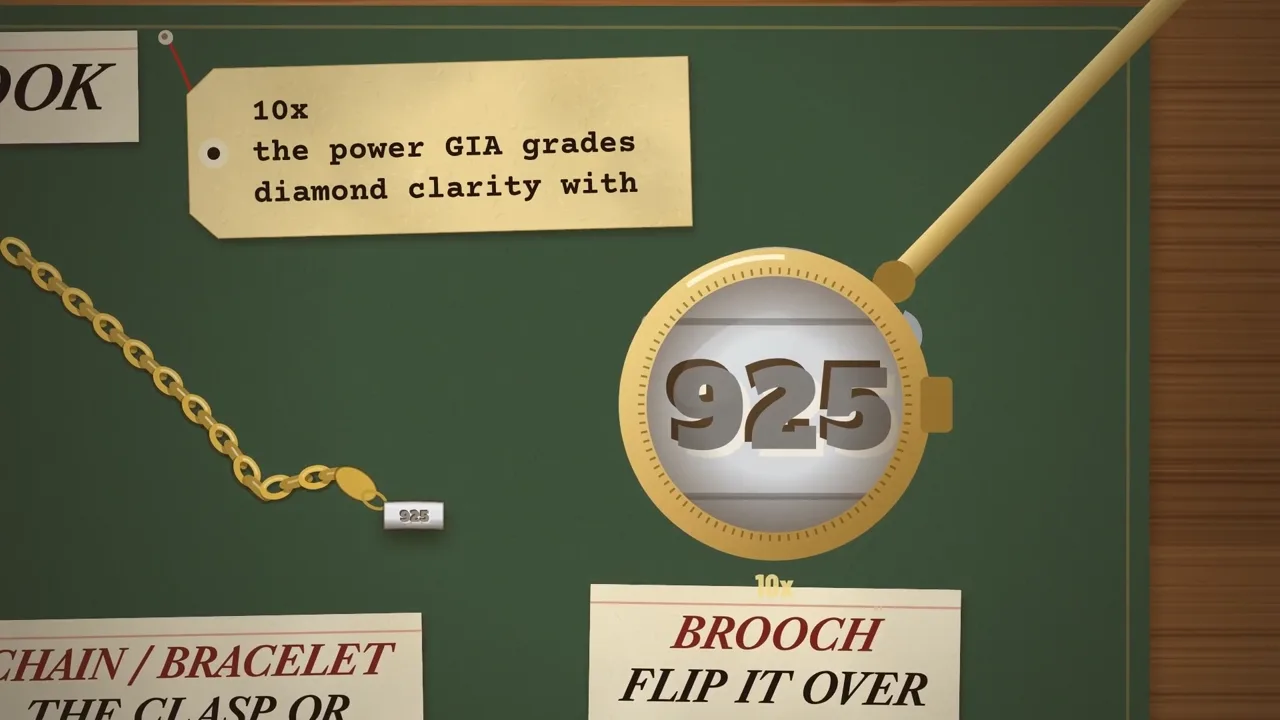
Look in three places: inside the band on a ring, on the clasp or a little tag next to it on a chain or bracelet, and on the back of a brooch. The stamps are tiny, so bring a 10x loupe, the same power GIA uses to grade diamond clarity.
There are two kinds of marks:
- A quality mark tells you the metal: 14K, 18K, 925.
- A maker's mark tells you who made it: a company name or an artist's initials.
Under federal law (15 U.S.C. 297(b)), whoever stamps a gold or silver quality mark is supposed to put their trademark or name as close as possible to it. The FTC's own advice for gold jewelry: if you don't see a trademark along with the karat mark, don't buy it.
And keep this in mind for the whole list: a mark is a claim, not proof. More on that at the end.
What does 14K or 585 mean, and what do 14K rings sell for?
14K means the piece is 14-karat gold, and 585 is the same mark written as a number: about 58.5% gold. It's the mark everyone should know.
On eBay, the middle half of 32 vintage 14K gold ring sales (Oct 26 to Nov 5, 2026) landed between about $275 and $660, with a median around $415.
- A 4-gram 14K band with no stones sold for $250 on Nov 3, 2026.
- An amethyst and diamond ring sold for $1,090.01 the same day.
Price follows the gold weight, plus the stones. So at the sale, pick up every gold-colored ring and read the inside of the band.
What does 18K or 750 mean on a gold chain?
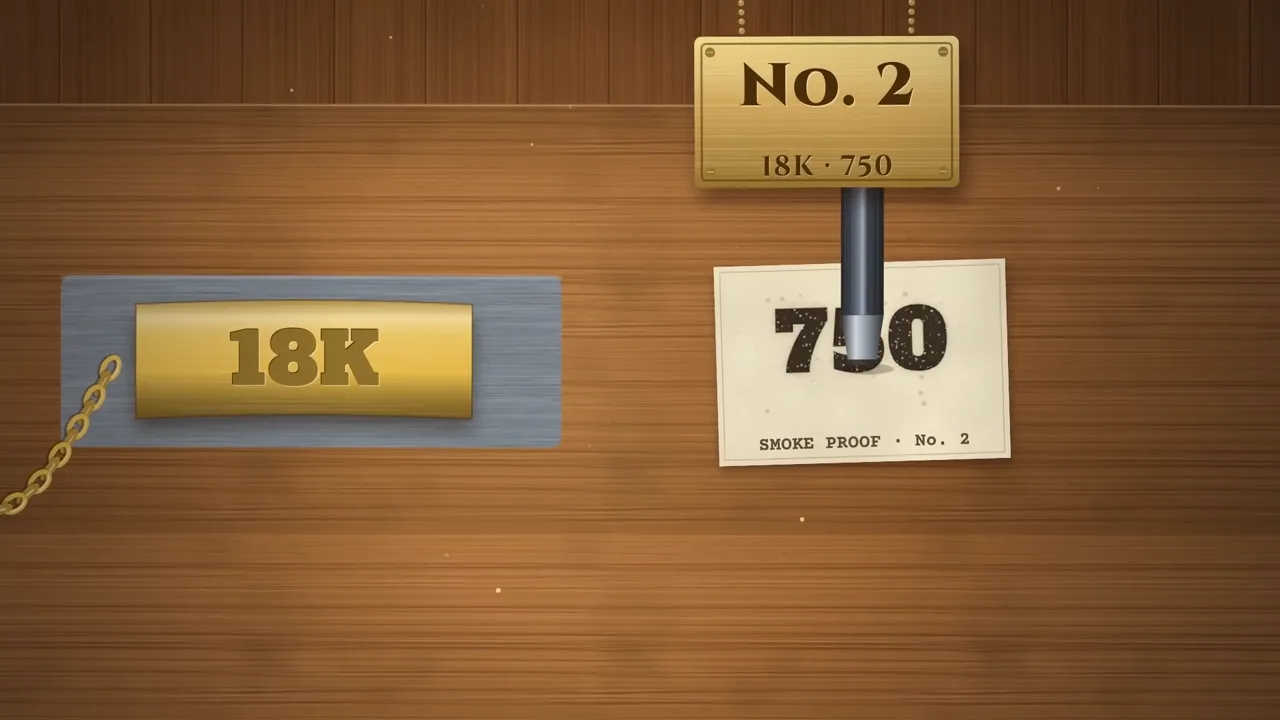
18K, or 750, means 75% gold. With solid gold chains, the price follows the weight.
| 18K / 750 chain | Weight | Sold for | Sold |
|---|---|---|---|
| Thin chain marked 750 | 2.8 g | $315 | Oct 22, 2026 |
| Italian rolo chain | 9.5 g | $1,550 | Nov 4, 2026 |
| Anchor chain, new (other) | 24.54 g | $2,459.50 | Nov 1, 2026 |
The middle half of 25 solid 18K chain sales (Sep 24 to Nov 4, 2026) ran from about $550 to $1,400. That's why a little pocket gram scale is worth carrying to estate sales.
What do GF, RGP and HGE mean on gold jewelry?
They mean the piece looks like gold but isn't solid gold. GF is gold filled, RGP is rolled gold plate, and HGE is heavy gold electroplate. You'll also see marks like "1/20 12K GF".
Here's what the FTC Jewelry Guides (16 CFR 23.3) say each term means:
| Mark | What the FTC Jewelry Guides require |
|---|---|
| GF (gold filled) | a layer of at least 10K gold that makes up at least 1/20 of the metal's weight |
| RGP (rolled gold plate) | the same kind of layer, but at least 1/40 of the weight |
| Gold electroplate | at least 0.175 microns of gold, about 7 millionths of an inch |
| HGE (heavy gold electroplate) | at least 2.5 microns, about 100 millionths of an inch |
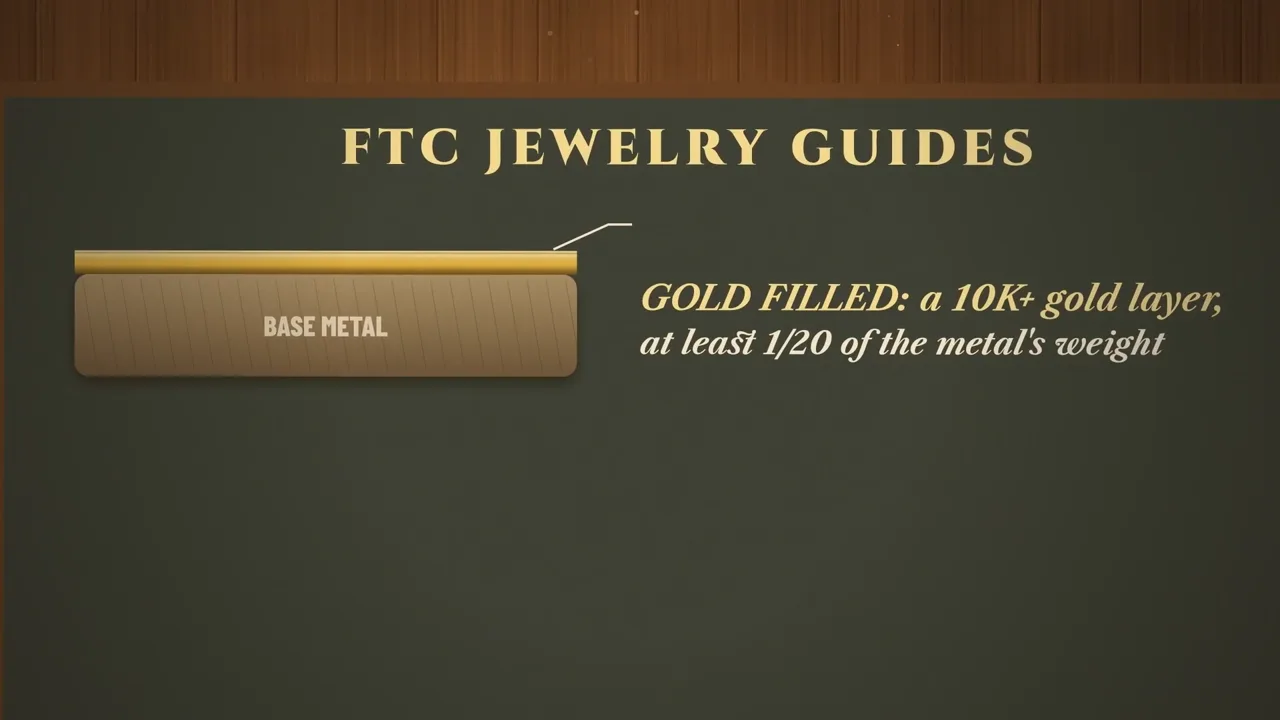
The price difference is huge. The chain listed as "Italy Au750 18K GF" sold for $56 on Oct 29, 2026, and all 13 gold-filled chains on that same eBay sold page went for $27 to $67. Notice the cheap chain also says Au750: the letters after the K are the tell, not the 750.
A ring listed as "14k Yellow Gold Shell" sold for $45 on Nov 4, 2026, the day after a 4-gram 14K band sold for $250. "Gold shell" isn't a term the FTC guides define, so any extra word after the K is a reason to slow down.
Two rules: read every letter after the K, and remember that a 14K clasp on a chain only tells you about the clasp.
How do you tell if Mexican silver is sterling?
Look for 925, which means sterling (92.5% silver), together with "Mexico" and often the word "Taxco". A Mexico 925 stamp is still a claim, so treat it like any other mark.
A little history helps you date a piece. William Spratling, who helped revive Mexican silver, opened his first workshop in Taxco in 1931. Older Mexican pieces may carry an eagle stamp, used from the late 1940s until about 1980. After that you'll see codes like TE-43: the T means Taxco, and the next letter is the first letter of the maker's last name.
Most vintage Taxco sterling cuffs sold between $40 and $150: 16 of 22 sales from Oct 27 to Nov 3, 2026. A heavy 75.5-gram leaf bracelet with Taxco as the brand sold for $219.27 on Nov 3, 2026. Weight and a maker's signature are the money.
How much is a Tiffany Return to Tiffany bracelet worth?
More than half of the heart tag bracelet sales counted on eBay from Oct 11 to Oct 27, 2026 landed between $140 and $250. A boxed toggle bracelet with eBay's Authenticity Guarantee sold for $549.99 on Oct 26, 2026.
Return to Tiffany goes back to 1966, when Tiffany started selling key tags that read "Please Return to Tiffany & Co. New York." Today you'll find that line on heart tag bracelets.
eBay says its Authenticity Guarantee is free for eligible jewelry priced at $500 and above (eBay's page, checked Nov 6, 2026). But a Tiffany stamp alone isn't proof. If you can't confirm it's real, don't list it as Tiffany.
What does the James Avery mark look like?
It's a tiny stamped candelabra with the letters J and A. James Avery started in 1954 in Kerrville, Texas, and the company officially retires designs. Retired ones brought the top prices.
- 12 of 19 single James Avery charm sales on Oct 27-28, 2026 landed between $40 and $115.
- A sailboat charm listed as retired sold for $170 (Oct 28, 2026).
- A retired enamel teapot charm sold for $425 (Oct 28, 2026).
- A Key to My Heart charm went for $20 (Oct 28, 2026).
"Retired" is the seller's word in those listings, so check the design against James Avery's own retired list before you pay up.
How much is Eisenberg Original jewelry worth?
The middle half of 38 eBay sales of pieces signed "Eisenberg Original" (Oct 2 to Nov 4, 2026) landed between $95 and $300, with a typical sale around $155. Flip the brooch over: the signature is on the back.
Eisenberg started as a Chicago dress maker, and the jewelry began as trim on the dresses. Collectors date the "Eisenberg Original" mark to about 1935-1945, and from 1943, during the war, some pieces were made in sterling.
The sterling ones went highest:
- A sterling pin with red stones sold for $685 with 20 bids (Oct 23, 2026).
- A sterling fur clip with a big aqua glass stone sold for $1,009.99 with 22 bids (Oct 31, 2026). That's one sale, the top one found, not the norm.
These prices are for pieces signed "Eisenberg Original" only, not later Eisenberg.
How do you identify Miriam Haskell jewelry?
On signed necklaces, look for her name on the back of the clasp. Miriam Haskell opened in New York in 1926, but most Haskell from before about 1950 isn't signed, so an unsigned piece can still be old.
Signed Haskell necklaces: the middle half of 42 eBay sales (Oct 13 to Nov 5, 2026) ran from $46 to $125, typical around $72. A choker listed as 1940s sold for $949 with 40 bids on Oct 27, 2026, but that's one sale, not the norm. A choker listed "as found" went for $29.10.
Is Weiss jewelry worth anything?
Yes, but modestly. Weiss is a real mark from Albert Weiss & Co. in New York, 1942 to 1971. Most single signed Weiss brooches sold between $26 and $60 (20 of 26 eBay sales, Oct 26 to Nov 5, 2026), with a median around $35. The top one, a flower pin with multicolor stones, sold for $110.
Fake Weiss pieces have been sold online too, so judge the quality of the piece, not just the name.
How do you test Bakelite jewelry?
Bakelite has no mark, so the test is the mark. Leo Baekeland invented Bakelite in 1907, and a lot of the colorful jewelry collectors call Bakelite is a close cousin, cast phenolic, sold in the United States from 1927.
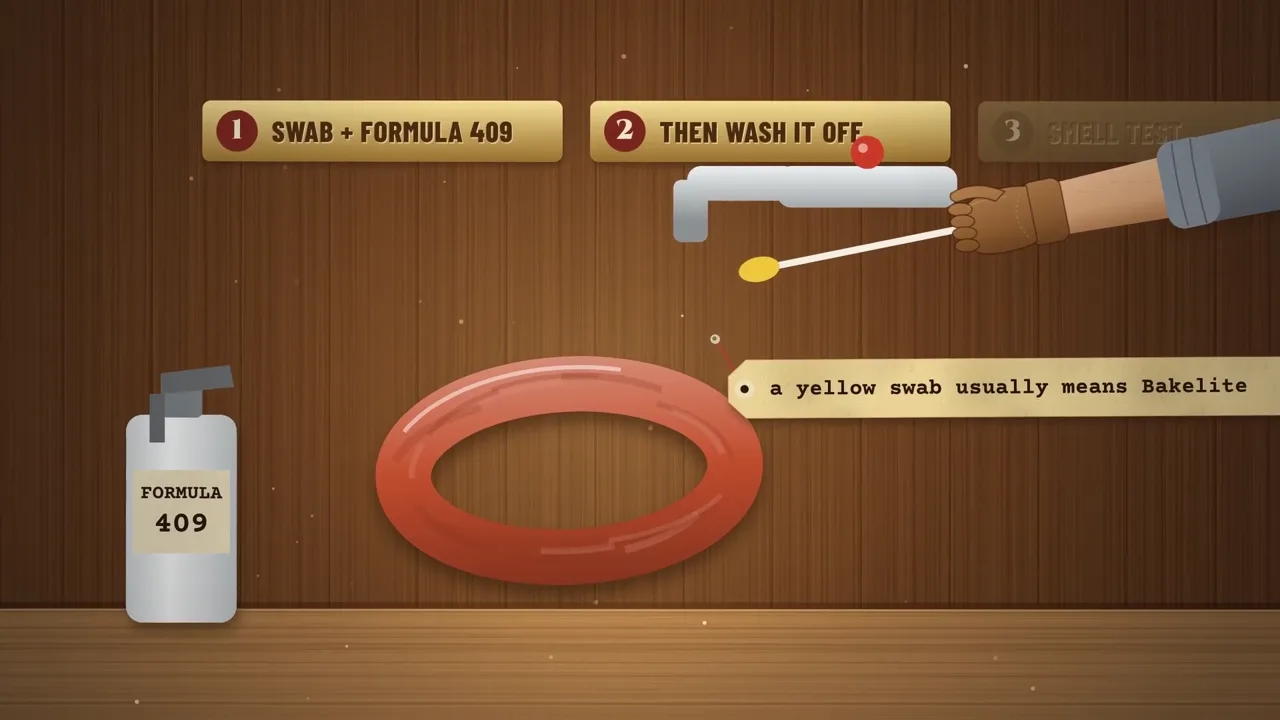
What resellers do:
- Rub a hidden spot with a cotton swab and Formula 409, then wash it off. A yellow swab usually means Bakelite.
- Or run it under hot tap water and smell it.
The catch: real pieces don't always pass. Black and many red pieces often don't react, and Simichrome polish can give a false yellow. And skip the hot pin test. It damages the piece.
Bangles listed as tested Bakelite: the middle half of 43 eBay sales (Oct 23 to Nov 5, 2026) ran from $25 to $130, typical around $47. Carving and dots are the money. A marbled bangle with yellow polka dots sold for $299 (Oct 29, 2026), and a deeply carved snakes clamper sold for $425 (Oct 26, 2026).
What are Native American jewelry hallmarks worth, and what does the law say?
An artist's hallmark on Native American sterling and turquoise is number 11. Signed vintage cuffs listed as Navajo: the middle half of 41 eBay sales (Oct 17 to Nov 5, 2026) ran from $97 to $320, typical around $210.
Named artists and big stones went higher. A cuff listed as signed by Frank Yellowhorse sold for $550 (Oct 30, 2026), and a cuff listed as a signed 1970s piece with Bisbee turquoise sold for $1,150 (Oct 22, 2026). Those are the sellers' descriptions, not ours.
This is the one where the wording is the law. The Indian Arts and Crafts Act (18 U.S.C. 1159) makes it illegal to offer or sell anything in a way that falsely suggests it's Native American made. For an individual's first offense, penalties go up to $250,000 and/or 5 years when it's offered or sold for $1,000 or more, and up to $25,000 and/or 1 year below that.
So only call it Navajo, or name an artist, if you can document it. Otherwise, describe what you can prove: Southwestern style, maker unknown. This isn't legal advice; check the rules yourself.
Does a jewelry stamp prove it's real?
No. A stamp is a claim, not proof, which is why the law sets penalties for false marks (15 U.S.C. 294 and 298).
- The magnet test: gold and silver aren't magnetic. If a magnet grabs the piece itself, not just the clasp (clasps can have a steel spring), it isn't solid gold or sterling. If it doesn't grab, that proves nothing, because brass and copper don't stick either.
- Get it tested: before you sell anything as solid gold, get an acid test or an X-ray metal test at a jeweler or a gold buyer.
- List only what you've checked: never list something as gold, sterling, Bakelite or a designer piece unless you've checked it.
Once a piece checks out, EasyFlip writes the eBay listing from a few photos: title, description, item specifics, category and a suggested price. See how it works.
The bottom line: the quick check at the sale
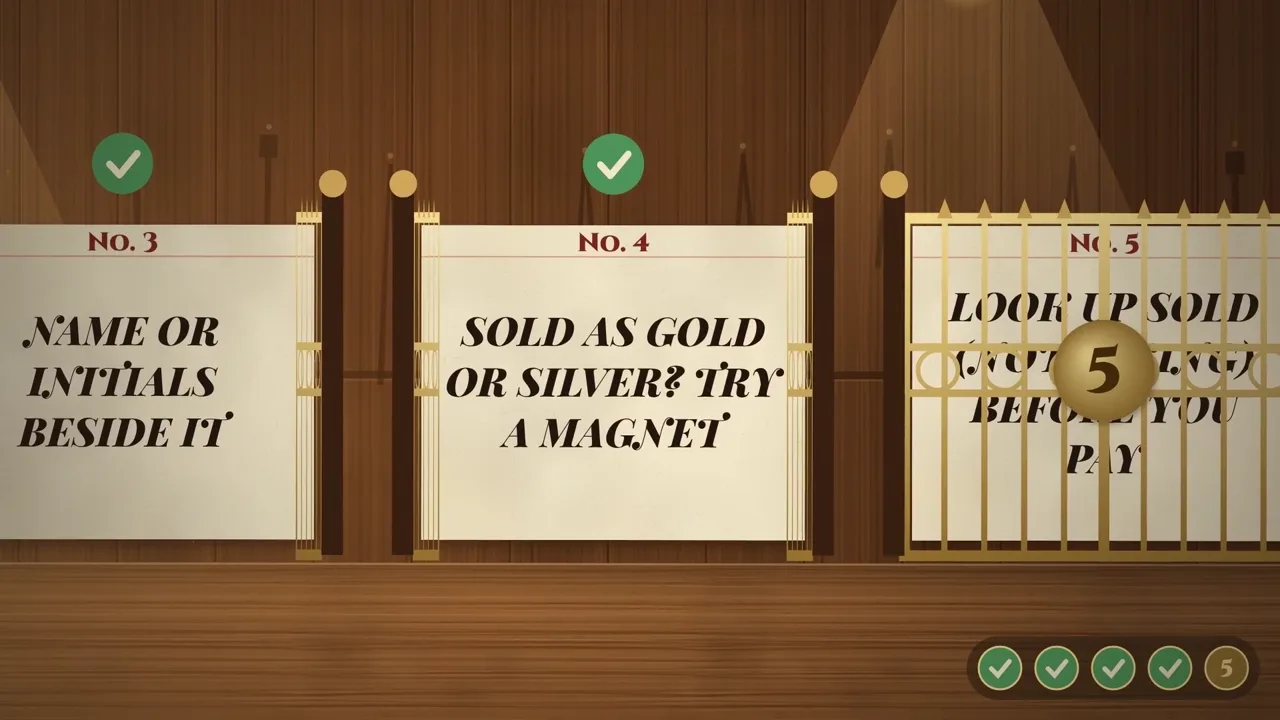
Do this with every piece at your next estate sale:
- Flip it over and find the mark.
- Read every letter after the K.
- Look for a name or initials beside it.
- If it's sold as gold or silver, try a magnet.
- Look up the sold price on eBay, not the asking price, before you pay.
Want what's selling every week? Get the free Easy Flip newsletter, every Monday.
Questions people ask
What does 18K GF mean on jewelry?
GF means gold filled: under the FTC Jewelry Guides, a layer of at least 10K gold that makes up at least 1/20 of the metal's weight, over a base metal. It isn't solid gold. On eBay, all 13 gold-filled chains on one sold page went for $27 to $67, including one listed "Italy Au750 18K GF" at $56 on Oct 29, 2026.
Is 585 the same as 14K gold?
585 is the number form of the 14K mark and means about 58.5% gold. Vintage 14K rings sold on eBay for $275 to $660 in the middle half of 32 sales from Oct 26 to Nov 5, 2026, with a median around $415.
Does a magnet test tell you if gold is real?
Only one way. Gold and silver aren't magnetic, so if a magnet grabs the piece itself, not just a steel clasp spring, it isn't solid gold or sterling. If it doesn't grab, that proves nothing, because brass and copper don't stick either; get an acid test or an X-ray metal test at a jeweler or gold buyer.
How much is Eisenberg Original jewelry worth?
The middle half of 38 eBay sales of pieces signed "Eisenberg Original" (Oct 2 to Nov 4, 2026) landed between $95 and $300, typical around $155. Sterling pieces went highest: one sterling fur clip sold for $1,009.99 with 22 bids on Oct 31, 2026, but that's one sale.
How do you test Bakelite without damaging it?
Resellers rub a hidden spot with a cotton swab and Formula 409, then wash it off; a yellow swab usually means Bakelite. Hot tap water and a sniff is another check. Real black and many red pieces often don't react, Simichrome can give a false yellow, and the hot pin test damages the piece, so skip it.
Can I sell jewelry as Navajo if it looks Native American?
Only if you can document it. The Indian Arts and Crafts Act makes it illegal to offer or sell anything in a way that falsely suggests it's Native American made, with penalties for an individual's first offense up to $250,000 and/or 5 years at $1,000 or more. Otherwise describe what you can prove, like "Southwestern style, maker unknown"; this isn't legal advice.
Sources
Prices are eBay sold listings, and every fact below was checked on November 6, 2026.
- FTC Jewelry Guides, 16 CFR Part 23 (checked Nov 6, 2026)
- FTC, buying platinum, gold and silver jewelry (checked Nov 6, 2026)
- National Gold and Silver Stamping Act, 15 U.S.C. 297 (checked Nov 6, 2026)
- Indian Arts and Crafts Act, IACB (checked Nov 6, 2026)
- eBay Authenticity Guarantee, jewelry (checked Nov 6, 2026)
- Tiffany & Co., Return to Tiffany history (checked Nov 6, 2026)
- James Avery, 70 years (checked Nov 6, 2026)
- William Spratling, LACMA (checked Nov 6, 2026)
- Leo Baekeland, Science History Institute (checked Nov 6, 2026)
- GIA, 10x clarity grading (checked Nov 6, 2026)
- eBay sold listings (Sold + Completed, US sellers), sales Sep 24-Nov 5, 2026
Read the full video transcript
Two chains sold on eBay less than a week apart, and both listings say eighteen K. One sold for fifteen hundred fifty dollars. The other sold for fifty-six dollars, because two more letters came after the eighteen K. So in this video: eleven jewelry marks you'll find at estate sales, what each one really sold for on eBay, and the quick check before you pay. One mark goes on pieces that look exactly like solid gold, and they aren't. One brooch signature hides in costume jewelry boxes, and the best one I found sold for just over a thousand dollars. And one bracelet has no mark at all, so the test is the mark. Let's jump right into it.
So first, where to look. On a ring, the mark is inside the band. On a chain or a bracelet, it's usually on the clasp or a little tag next to it. On a brooch, flip it over. Bring a ten-times loupe, the same power GIA grades diamonds with, because these stamps are tiny. There are two kinds of marks. A quality mark tells you the metal, like fourteen K or nine twenty-five. A maker's mark tells you who made it, a company name or an artist's initials. Under federal law, whoever stamps a gold or silver quality mark is supposed to put their trademark or name right next to it. The FTC's own advice for gold: if you don't see a trademark along with the karat mark, don't buy it. And here's something to be wary about: a mark is a claim, not proof. I'll come back to that at the end. Number one is the mark everyone should know: fourteen K, or the number five eighty-five. Five eighty-five means about fifty-eight and a half percent gold. On eBay, the middle half of thirty-two recent sales of vintage fourteen K gold rings landed between about two hundred seventy-five and six hundred sixty dollars, and the typical one was around four hundred fifteen. Even a four-gram fourteen K band with no stones sold for two hundred fifty dollars on November third. An amethyst and diamond ring sold for one thousand ninety dollars the same day. Price follows the gold weight, plus the stones. So at the sale, pick up every gold-colored ring and read the inside of the band.
Quick thing before we keep going. If you've got a pile of stuff waiting to be listed, that's exactly why I built EasyFlip. Snap a few photos and it writes the whole eBay listing for you: title, description, item specifics, the category, even a price. You check it, tap publish, done. Link's down below.
Number two is eighteen K, or seven fifty, which means seventy-five percent gold. And with solid gold chains, the price follows the weight. A thin chain marked seven fifty, two point eight grams, sold for three hundred fifteen dollars. A nine and a half gram rolo chain sold for fifteen hundred fifty on November fourth. And a new twenty-four gram anchor chain went for two thousand four hundred fifty-nine dollars and fifty cents. The middle half of twenty-five solid eighteen K sales ran from about five hundred fifty to fourteen hundred dollars. So a little pocket gram scale is worth carrying. Number three is the one from the start, the marks on pieces that look exactly like gold: the plated marks. G F is gold filled. R G P is rolled gold plate. H G E is heavy gold electroplate. And you'll see things like one twentieth, twelve K, G F. Under the FTC's jewelry guides, gold filled means a layer of at least ten karat gold that makes up at least one twentieth of the metal's weight. Rolled gold plate only needs one fortieth. And plain gold electroplate only has to be about seven millionths of an inch thick. That chain listed as eighteen K G F sold for fifty-six dollars, and all thirteen gold-filled chains on that same page sold between twenty-seven and sixty-seven dollars. And a ring listed as fourteen K gold shell sold for forty-five dollars, the day after a four-gram fourteen K band sold for two hundred fifty. Any extra word after the K is a reason to slow down. So read every letter after the K. And a fourteen K clasp on a chain only tells you about the clasp.
Number four: nine twenty-five, which means sterling, ninety-two and a half percent silver. Look for Mexico and nine twenty-five, and often the word Taxco. William Spratling, who helped revive Mexican silver, opened his first workshop in Taxco in nineteen thirty-one. Older Mexican pieces may carry an eagle stamp, used from the late nineteen-forties until about nineteen eighty. After that you'll see codes like T E forty-three: the T means Taxco, and the next letter is the first letter of the maker's last name. Most vintage Taxco sterling cuffs sold between forty and a hundred fifty dollars, sixteen of twenty-two sales. A heavy seventy-five gram leaf bracelet sold for two hundred nineteen dollars on November third. Weight and a maker's signature are the money. Number five: Tiffany and Company. Return to Tiffany goes back to nineteen sixty-six, when Tiffany started selling key tags that read Please Return to Tiffany and Company, New York. Today you'll find that line on heart tag bracelets. More than half of the heart tag bracelet sales I counted in October landed between a hundred forty and two hundred fifty dollars. A boxed toggle bracelet with eBay's Authenticity Guarantee sold for five hundred forty-nine dollars and ninety-nine cents on October twenty-sixth. eBay says eligible jewelry priced at five hundred dollars and up gets authenticated for free under that guarantee. But a Tiffany stamp alone isn't proof, so if you can't confirm it's real, don't list it as Tiffany. Number six is tiny: James Avery. It started in nineteen fifty-four in Kerrville, Texas, and the mark is a little stamped candelabra with the letters J and A. The company officially retires designs, and retired ones brought the top prices. Twelve of nineteen single charm sales over two days in late October landed between forty and a hundred fifteen dollars. A sailboat charm listed as retired sold for a hundred seventy, and a retired enamel teapot charm sold for four hundred twenty-five dollars on October twenty-eighth. A key charm went for twenty.
Number seven is the brooch from the start: Eisenberg Original, signed on the back. Eisenberg started as a Chicago dress maker, and the jewelry began as trim on the dresses. Collectors date the Eisenberg Original mark to about nineteen thirty-five to forty-five, and from nineteen forty-three, during the war, some pieces were made in sterling. The middle half of thirty-eight sales landed between ninety-five and three hundred dollars, typical around a hundred fifty-five. And the sterling ones went highest. A sterling pin with red stones sold for six hundred eighty-five with twenty bids, and a sterling fur clip with a big aqua glass stone sold for one thousand nine dollars and ninety-nine cents on October thirty-first, with twenty-two bids. These prices are for pieces signed Eisenberg Original only, not later Eisenberg. Number eight: Miriam Haskell. She opened in New York in nineteen twenty-six, but most Haskell from before about nineteen fifty isn't signed. On signed necklaces, look for her name on the back of the clasp. Signed Haskell necklaces: the middle half of forty-two sales ran from forty-six to a hundred twenty-five dollars, typical around seventy-two. A choker listed as nineteen-forties sold for nine hundred forty-nine dollars with forty bids, but that's one sale, not the norm. A choker listed as found went for twenty-nine. Number nine is a smaller one: Weiss, from Albert Weiss and Company in New York, nineteen forty-two to nineteen seventy-one. It's a real mark, just a modest one. Most single signed Weiss brooches sold between twenty-six and sixty dollars, typical around thirty-five, and the top one, a colorful flower pin, sold for a hundred ten. Fake Weiss pieces have been sold online too, so judge the quality, not just the name.
Number ten has no mark at all: Bakelite. Leo Baekeland invented it in nineteen oh seven, and a lot of the colorful jewelry collectors call Bakelite is a close cousin, cast phenolic, sold in the United States from nineteen twenty-seven. With Bakelite, the test is the mark. Resellers rub a hidden spot with a cotton swab and Formula four oh nine, then wash it off, and a yellow swab usually means Bakelite. Or run it under hot tap water and smell it. But real pieces don't always pass, black and many reds often don't react, and Simichrome polish can give a false yellow. And skip the hot pin test. It damages the piece. Bangles listed as tested Bakelite: the middle half of forty-three sales ran from twenty-five to a hundred thirty dollars, typical around forty-seven. Carving and dots are the money. A bangle with yellow polka dots sold for two hundred ninety-nine, and a deeply carved snakes clamper sold for four hundred twenty-five dollars on October twenty-sixth. Number eleven is an artist's hallmark on Native American sterling and turquoise. Signed vintage cuffs listed as Navajo: the middle half of forty-one sales ran from ninety-seven to three hundred twenty dollars, typical around two hundred ten. Named artists and big stones went higher. A cuff listed as signed by Frank Yellowhorse sold for five hundred fifty, and a cuff listed as a signed nineteen-seventies piece with Bisbee turquoise sold for eleven hundred fifty dollars on October twenty-second. Those are the sellers' descriptions, not mine. And this is the one where the wording is the law. The Indian Arts and Crafts Act makes it illegal to offer or sell anything in a way that falsely suggests it's Native American made. For an individual's first offense, fines go up to two hundred fifty thousand dollars when it's offered or sold for a thousand dollars or more, with smaller penalties below that. So only call it Navajo, or name an artist, if you can document it. Otherwise, describe what you can prove: Southwestern style, maker unknown. I'm not a lawyer, so check the rules yourself.
Now, the warning from the start. A stamp is a claim, not proof. That's why the law sets penalties for false marks. Gold and silver aren't magnetic. So if a magnet grabs the piece itself, not just the clasp, it isn't solid gold or sterling. But if it doesn't, that proves nothing, because brass and copper don't stick either. Before you sell anything as solid gold, get it tested, with an acid test or an X-ray metal test at a jeweler or a gold buyer. And never list something as gold, sterling, Bakelite or a designer piece unless you've checked it. So here's the quick check at the sale. One: flip it over and find the mark. Two: read every letter after the K. Three: look for a name or initials beside it. Four: if it's sold as gold or silver, try a magnet. And five: look up the sold price on eBay, not the asking price, before you pay.
So, what's the best piece of jewelry you've found with a mark you almost missed? Tell me the mark and what you paid in the comments. And if this helps you spot one, a like helps it reach more resellers. Have a blessed day.